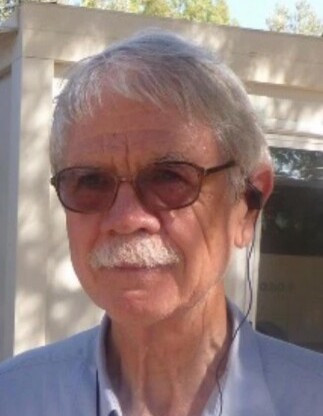
Professor Emeritus F. Douglas Kelly, Jr.
1934-2022
Biography
Frederick Douglas Kelly, Jr. was born in El Monte, CA, on July 17, 1934; he passed away in Madison, WI, on March 21, 2022, at the age of 87.
Douglas Kelly spent his entire career of forty years in the Department of French and Italian at the University of Wisconsin–Madison and taught a wide range of courses and seminars on medieval French and Occitan literature, as well as several advanced undergraduate courses for the Medieval Studies Program. He directed over twenty dissertations of medieval specialists who have demonstrated their critical acumen and pedagogical expertise at colleges and universities across North America. In addition to his teaching responsibilities in French, Douglas also developed new interdisciplinary courses at the advanced undergraduate level for Medieval Studies. Douglas was the consummate departmental colleague: a constant voice of reason in many discussions, a firm believer in faculty governance, and a dedicated advocate for the university and its mission. His service to the university was exemplary, serving on, among others, the Graduate School Research Committee and the Steering Committee of the Medieval Studies Program, of which he also served a term as chair.
At the University of Wisconsin Douglas received numerous academic honors, including Senior Member of the Institute for Research in the Humanities, Romnes Fellow, Vilas Associate, Hilldale Award for the Humanities, and a WARF Professorship, named in honor of his own mentor, Julian Harris. In 1994, his colleagues and students presented him with a Festschrift, Conjunctures: Medieval Studies in Honor of Douglas Kelly. Other signal honors include the Prix Escalibur 1995, granted by the French Branch of the Société Internationale Arthurienne, the post of Senior Fellow at the Netherlands Institute for Advanced Study (1997-98), Fellow and Emeritus Fellow of the Medieval Academy of America (2017-2022). In 2018 Douglas received the Albert Nelson Marquis Lifetime Achievement Award.
Almost every year since the late 1960s, Douglas would make the trek to Kalamazoo, often in a University fleet vehicle, to attend the International Congress on Medieval Studies at Western Michigan University, where he would get together with his former graduate students and colleagues from around the world.
One of the great medievalists of his generation, Douglas Kelly was world-renowned authority in Arthurian Studies. His publications are too numerous to list, but his doctoral dissertation on Chrétien de Troyes’s Charette, published as ‘Sens’ and ‘Conjointure’ in the ‘Chevalier de la Charette’ (The Hague, Paris: Mouton, 1966) was the first in a series of books which revealed the foundations of vernacular romance in the Latin arts of poetry. His landmark study in the field of medieval romance is surely The Art of Medieval French Romance (Madison: University of Wisconsin Press, 1992), shortly followed by a synthesis of the topic in Medieval French Romance (New York: Twayne, 1993). It is no exaggeration to say that his work contributed to a major re-evaluation of the genre of medieval romance. He also edited several collections of essays by colleagues, some resulting from colloquia he had organized. His Analytic Bibliography of Chrétien de Troyes (1976) was followed by an important supplement (2002). Outside of Arthurian studies, Douglas Kelly published books on Medieval Imagination: Rhetoric and the Poetry of Courtly Love (Madison: University of Wisconsin Press, 1978), the Internal Difference and Meanings in the “Roman de la Rose” (Madison, London: University of Wisconsin Press, 1995), and, more recently, Christine de Pizan’s Changing Opinion (Cambridge: Brewer, 2007) and Machaut and the Medieval Apprenticeship Tradition (Cambridge: Brewer, 2014). Reviewers of these books without exception express admiration of Douglas Kelly’s erudition, noting that all were likely to mark watershed moments in the history of scholarship. A collection of earlier articles, The Subtle Shapes of Invention, was published in 2011. His last major publications were translations of the three romans antiques, co-authored with Glyn Burgess: Benoît de Sainte-Maure’s Roman de Troie (2017), and the Roman de Thèbes and the Roman d’Eneas (2021). His Festschrift, Conjunctures (1994), contained thirty-nine essays contributed by colleagues, former students, and friends from North America and Europe. Like the scholarship of luminaries of medieval studies such as Edmond Faral, Etienne Gilson or Ernst Robert Curtius, Douglas’s work will continue to stand the test of time and will be required reading for generations of medievalists. The breadth of his learning, the reach of his publications, and his own linguistic abilities (he spoke French, German, Italian, and some Dutch) allowed him to move freely in the world of international scholarship, where he developed lasting friendships and many collaborators.
Despite the honors and distinctions which came his way, Douglas Kelly remained irremediably modest about his own achievements. Douglas was very approachable and attentive to others, especially younger scholars. Affable and sociable, he was a comforting presence at conferences. Open to new and developing directions in Old French studies, Douglas Kelly nevertheless remained true to his convictions about the Latin underpinnings of vernacular literature. This he did because he knew the material better than anyone else. Many might have wanted to write a book such as The Art of Medieval French Romance, but only Douglas Kelly could have. He never set store by rank or seniority and simply considered himself as a member of the wider community of scholars, almost to the point of self-effacement. Aware, nevertheless, that learned societies sometimes needed steady guidance, Douglas Kelly shouldered the burden of office. He was Vice-President of the International Arthurian Society (1981–1984), Secretary and Editor of its Bibliographical Bulletin (1984–1993), and President of the International Courtly Literature Society (1983–1989).
Douglas Kelly’s long and valuable presence in, and his many and diverse contributions to, his Department, to the University, to the profession more generally, and to medieval studies are reminders of the crucial role he played in our collective academic life and monuments to his magnanimous spirit. He was a great scholar, teacher, and the best of men.
Douglas is survived by his wife, Sandra; stepson, Geoffrey Ihle; loving sons: Stephen (Linda), David (Tamea); and grandchildren: Alison, Bret, and Jaime. He is also survived by his brother, Arthur Kelly (Judy) and sister-in-law, Judy Kelly.